Showing posts with label Prayer. Show all posts

Sunday, July 5, 2009

The Proper Perspective on Prayer - Part II


Luke chapter 18 begins with the statement,

“And he spake a parable unto them to this end,
that men ought always to pray, and not to faint;”

Jesus preached prayer, and he practiced prayer.

In Luke 6:12 Jesus spent the entire night in prayer before choosing his twelve disciples. In Matthew 14:23 Jesus departs into a mountain to pray alone. After being baptized by John in the Jordan River, the spirit of God drove him into the wilderness for 40 days of prayer and fasting. We see him in the Garden of Gethsemane the night before the crucifixion praying for God’s will to be done, for the apostles, for the coming church, and even for you and I – those who would believe through the Apostles’ ministry.

Christ was all about prayer.

Men of God were all about prayer.

- Seth prayed in the book of Genesis and men began to call on God.
- Noah prayed and God instructed him to build an Ark
- Abraham prayed and gave him a promise and a people
- Jacob prayed and wrestled with an angel
- Joseph prayed and was elevated to the highest offices of Egypt.
- The Hebrews prayed and God raised up Moses
- Moses prayed and God parted the Red Sea
- The Israelites prayed and God gave them manna from Heaven
- Joshua prayed and the sun stood still for 24 hours
- Samson prayed and renewed his strength
- Deborah prayed and delivered a nation
- Gideon prayed and destroyed the enemy
- David prayed and defeated his giant
- Solomon prayed and found wisdom

And the list goes on and on.

Prayer is one of the most basic fundamentals of Christian living. It is our refuge, our medium for obtaining supernatural power in a natural world. It is our source for boldness to proclaim the gospel, Grace to face the toughest situations, and hope for a promised future. It is our means of communicating with an interested Father.

It is our way of life.

“To be a Christian without prayer is no more possible than to be alive without breathing.” – Martin Luther King Jr. –

In part 1, we discussed what prayer is not. In this post we look at what prayer is.

A way to bring your mind and heart in line with God’s

In prayer, we surrender to God, making his priorities our own. While teaching the disciples to pray he noted the importance of submitting our preferences to his will.

“Our Father in heaven, Hallowed be your name. Your kingdom come. Your will be done on earth as it is in heaven” (Matthew 6:9-10)

Prayer does not twist the arm of a disinclined God. Rather, it gives God permission to work in our lives and bring us in line with his thoughts, priorities, and desires.

God has given us free will. He will not force himself, or his desires, into our lives. We can not automatically assume that he will step into our situations and act on our behalf without our expressed invitation.

As David Bernard notes in his book Growing A Church

“Prayer does not change God’s attitude, but it changes our attitude so that we are ready to receive what God has planned for us.

Prayer molds and transforms us so that we are prepared to receive the answers that God wants to give us.”

In short, Bernard concludes, prayer gives us the ability to

1. discern God’s will
2. to do God’s will

Christ himself gave us an example of this when he prayed in the Garden of Gethsemane.

“And he was withdrawn from them about a stone's cast, and kneeled down, and prayed,

Saying, Father, if thou be willing, remove this cup from me: nevertheless not my will, but thine, be done.”
(Luke 22:41-42)

We can come to God and ask him to move how we want him to, but in the end we must always leave prayer submitted to doing it God’s way.

When we get lost in prayer, truly lost in prayer, it transforms our minds and brings them in line with God’s mind. It brings our hearts in line with God’s heart. It makes God’s priorities our priorities. It makes God’s desires our desires.

Prayer is how we bring our minds, our hearts, our wills, and our priorities in line with God’s

It is also,

A way to die to your old nature so that Christ can be formed in you.

The apostle Paul made the statement.

“My little children, of whom I travail in birth again until Christ be formed in you,” (Galatians 4:19)

The word formed means “to fashion.”

Prayer is a way for us to die to our old nature of sin so that Christ can be fashioned in our lives. Paul said, “I die daily.”

A daily prayer life will consistently kill the old man so that God can fashion us into the man or woman of God he has purposed for us to be.

Jesus told the disciples, “Pray that ye enter not into temptation.” (Luke 22:40). Every one of us will face temptation, but a consistent and daily prayer life will stop us from giving in to those temptations.

Paul told the Galatians, “This I say, walk in the Spirit, and ye shall not fulfill the lust of the flesh.” (Galatians 5:16)

Prayer has a way of keeping our spirits in subjection to the will of God, allowing us to walk in the Spirit of God and not after the manner of our flesh.

If you find yourself struggling with the desires of the flesh; that is a good indication that your prayer life is in a weak spot right now. Prayer, coupled with fasting, will crucify your flesh. It will bring your flesh under subjection to the spirit of God.

It will kill your fleshly, humanistic desires, and it will birth in you Godly desires.


Wednesday, July 1, 2009

The Proper Perspective on Prayer - Part I


Whatever your view point on prayer is, we should all agree that prayer is a necessary component in a Christian’s life if they are going to grow in Christ.

Doctrinally speaking…

There are three basic fundamentals to Christian living. As a child of God, you will not grow in God’s grace without these three fundamentals actively working in your life.

Church will give you a measure of growth. Weekly services will give you a measure of growth. However, if your life lacks these three fundamentals, then your growth will be greatly hindered if existent at all.

The first fundamental is the word of God. Without the word of God active in your life, you can not grow beyond the maturity level of a babe in Christ.

The second fundamental is fasting. Fasting is a way for us to crucify our flesh so that the desires and lusts of our flesh will pass away and God’s nature can be revealed in a greater light through us.

The third fundamental is of course, prayer.

But……

Before we discuss what prayer is, let us examine what prayer is not.

Prayer is not twisting God’s arm.

We do not pray to get God to do what we want him to do. It is ok to go to God with supplications and prayer requests, asking God to move in your life, but we do not go to God for the purpose of persuading him to act.

You don’t have to persuade God.

Who is sly enough in negotiating that they can be successful in persuading God? He knows every thought you think. Every word you say before you even say it. He knows the desires, the motivations, and the intentions of your heart.

Persuade – to prevail on someone to do something. To induce to believe, to convince.

Who can convince God of something? He already knows everything! Who can prevail on him and induce him to believe what they want him to believe? No one can.

Paul asked the question, “For do I now persuade men or God?” (Galatians 1:10).

Later, this same apostles declares

“For I am persuaded, that neither death, nor life,
nor angels, nor principalities, nor powers,
nor things present, nor things to come,

nor height, nor depth, nor any other creature,
shall be able to separate us from the love of God,
which is in Christ Jesus our Lord.”
(Romans 8:38-39)

Prayer does not give us the ability to persuade and twist God’s arm. Rather, prayer persuades us that God’s promises are yea and amen!

Prayer persuades us that God’s truth is real. It persuades us that God’s spirit is real. Prayer persuades us, and brings us in line with God’s way of thinking.

Not the other way around.

Prayer is not winning brownie points

Prayer is not a mechanical process whereby we earn favors from God. Rather it is a way of communicating with God and maintaining our relationship with him.

You don’t win brownie points by praying. Some people approach praying as a points system. For every hour you pray, you rack up points in heaven. If you pray thirty minutes, you rack up lesser points, but points none the less.

I’ve talked to people who sincerely believe God is obligated to do what they want him to do because they have been faithful in prayer. They act as if their time in prayer has been storing up brownie points for when they need to cash in on a divine favor.

God will always respond to prayer. I believe God will be swift to answer the prayers of a faithful saint. However, praying does not win us brownie points.

This isn’t Chuck-E-Cheese; we don’t win tickets that we can cash in later. Prayer allows us to build a consistent relationship with God; a relationship through which God will move and God will respond. However, prayer does not win us points that we can use to purchase power from God.

Prayer is not working to convince God to do what you want him to do.

I’ve often heard people in the prayer room begging God to move for them. I’ve heard people at the altar begging God to fill them with the Holy Ghost.

I’ve heard people begging God to heal their loved ones, save their children, touch a need, and respond to their voice.

We do not have to beg God.

God is not some obstinate deity sitting on a celestial throne saying, “C’mon, let me hear you beg.”

When we pray we should approach God in faith, believing that he rewards those that diligently seek him.

To beg God for something shows a lack of faith. We are working hard to convince him to do what we want him to do because we don’t believe he will do it without our convincing him.

Another reason people tend to beg God is because their prayer life, and general walk with God, is weak and they feel that God may be upset with them, or that they don’t have the influence they need with God.

So, if you find yourself begging God to move,

stop and evaluate why you are working to convince God to do something. Is it because your walk with God is weak at that time? If so, repent for the lack of faithfulness and believe God is still as willing and able to meet your need as ever.

If you are working to convince God because your faith is low, pray for faith and believe that God will hear you because you prayed.

Prayer is not just communication.

Prayer is not your daily “tag in” with God. It’s fine to talk to God about what has happened during your day, your week, this year, etc.

However, prayer is not where you come to God and give a report of what happened today.

It is so much more than that.

It is the intimate communication between a God and his people. It is the loving conversation between a father and his child.

It is our opportunity to bring God into our lives, and it is God’s opportunity to bring us into his heart.


To be continued…. Part II – What prayer is.

Tuesday, October 7, 2008

Praying with children at the altar - PART TWO


As a Children’s Evangelist, one of the things I wrestle with the most is the desire to give kids the Holy Ghost. I wish that every child, in every service, would receive the baptism of God’s Spirit.

I would often take this request to God, and before each service I would pray for God to fill kids with the Holy Ghost during the altar call. While I don’t believe there is anything inherently wrong with such a request, I realized one day that I was working to convince God to fill a child with his Spirit.

That is ridiculous!

God – in his own gentle way – reminded me one day in prayer that it was HE who had died for those children, NOT me. I realized at that moment what I was doing in prayer, and that I didn’t have to try and convince God to give someone the Holy Ghost…

He wants them to receive it more than I do!

HE died to give it to them!

When this simple revelation hit me, it created a paradigm shift in my thinking. I now understood that my purpose as a Children’s Minister was to get kids into the presence of God so that HE could do what he has purposed to do.

That is the goal of an altar service, to bring the children to a place where they can have an encounter with God and he is able to do in their hearts what he has purposed to do during that service.

Now, I said all that to say this – the steps that I am laying out in this post are those that my wife and I use when praying with a child to receive the Holy Ghost. Do they always receive the Holy Ghost? No. Not always.

There is no sure fire formula for getting kids to speak in tongues. There is no process, no procedure except to lead them through the Biblical plan of repentance and help them get to a place where God can do his thing.

That is your main goal as an altar worker. Lead them the Biblical way, and get them to God – he’ll do the rest.

So, how do you pray with a child at the altar?

If they want Jesus to give them the Holy Ghost

Ask them if they know what the Holy Ghost is: This may seem like a simple question, but the truth of the matter is that a lot of kids – even those raised in church - do not know exactly what the Holy Ghost is. When they hear Ghost, they think of Halloween or Casper, or the standard image that is associated with “Ghost.”

Explain to the child that the Holy Ghost is God coming to live in their hearts and that it is nothing to be afraid of. God loves them so much that he wants to live inside their hearts and he does that through the Holy Ghost.

Ask them if they know how to get the Holy Ghost: By the time a child gets to the altar, all they may know is that they need the Holy Ghost – after all, they have heard about it all service long.

But, they may not know how to receive it. Take the time to explain it to them. It is ok to stop a kid who is praying in order to make sure they have understanding. This will not quench the Spirit; instead it will focus the prayer.

Have the child raise their hands: Again, this step isn’t a necessity, but it teaches the child to be comfortable praying with raised hands, and encourages them to open up in prayer.

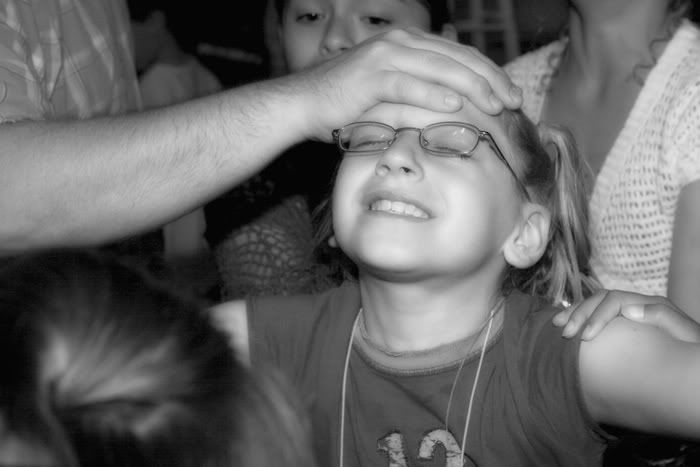
Ask if you can lay your hands on their head: Remember. It is very important that we mind where we touch a child during an altar service. Unless you are the parent of the child praying, I would recommend reserving your touching to their elbows – in order to support their arms – and their foreheads.

Always ask them if they mind you laying your hand on their forehead. We are not always privy to the history of each child and can inadvertently create uncomfortable feelings, even when our intentions are pure.

Lead them in repentance: Tell them that the Bible says that in order to receive the Holy Ghost we must first repent which means to ask God to forgive us for all the bad things we have done. Ask them if they have ever done things they knew they weren’t supposed to do; then tell them that is what sin is and we need to ask God to forgive us.

At this point I usually encourage the child to starting telling God about the things they have done wrong. If the child is praying, then I usually pray for them and ask God to give them a heart of repentance and Godly sorrow; if they are not praying, I usually lead them and give them direction on what to say.

Bro. Lloyd Squires, the Don of Children’s Ministry in our movement, suggests that we wait for tears. I agree. Tears are a good indicator that the child is getting in touch with God and is truly repenting. In all my experience I have only known one girl to receive the Holy Ghost without tears, and she was a unique case. Children are tender, and when we see the tears we know they are connecting.

Lead them in prayer: With kids it is often a necessity that those who are praying with them at the altar lead them in prayer. Many adults who come to the altar to pray do not have a clue on what to say or how to pray successfully. This is much more the case with kids.

It is ok to tell a child what to say during prayer. This shouldn’t be confused with teaching someone how to speak in tongues. The Holy Ghost can’t be taught – it is spirit directed, not man directed. However, we can give the child direction and give them words to speak. For example, I will often tell a child “talk to Jesus just like he is your best friend, because that is what he is. Tell him, ‘I love you Jesus,’ ‘I worship you,’ etc.” I’ve found that many times a child will take the direction and before long get into the groove of prayer and start praying themselves. Don’t be afraid to lead a kid in prayer, if they are left to try and figure it out on their own they won’t get it.

Additional Tips

Tell the kids what to expect: Kids don’t always know what to expect when the Holy Ghost begins to move on them. I often let them know that it is ok to say words that do not seem to make sense. I often see kids who will stop praying because they are trying to articulate their prayers when the Holy Ghost is taking control of their tongue and they feel like what they are about to say doesn’t make sense. Remind kids that when they start speaking in tongues, they won’t understand what they are saying and that they shouldn’t try to make their words sound like English.

Get them talking: Kids often have the tendency to come to the altar and just stand there with their head down and mouth closed. This is because they don’t know what they are supposed to do when at the altar. When praying for a child, make sure they are praying as well. God can’t cause them to speak in tongues if they aren’t talking. Admonish them not to just stand there, but to talk to God.

To illustrate this I often ask the kids if they have a best friend and what that best friend’s name is. I then ask if their friend has ever spent the night with them. When they say “yes,” I ask them if they just sit there and stare at their friend all night and never talk to them? This usually provokes a smile and a “no.” I inform them that praying is the same thing, Jesus wants to give them the Holy Ghost, but he can’t if they aren’t talking.

By leading a child in prayer we can help them learn what to say and how to pray. This is also true of kids who just cry when praying. I want these kids to feel the Spirit of God, so I try not to stop them from crying, but at the same time they can’t get the Holy Ghost without talking so I try to get them to talk and pray while they are feeling the moving of the Holy Ghost.

In conclusion

I want to remind you that a children’s altar call can vary drastically from an adult altar call. A lot of times, during an adult crusade, the altar call is given with high energy, emotionalism, and is filled with adults whose heart strings were pulled and conviction had set in during the preaching. While this is the case, at times, with kids as well, a lot of times it is not.

Kids have the unique ability to go from 0 to 60 in about 5 seconds when it comes to praying at the altar; they are sensitive and pure enough to do that. Often times when a child’s altar call is given, it may start off by looking like nothing is going to happen. I’ve felt this way before and God reminded me that he still has the power to create something, when nothing seems to exist. He reminded me that my job was to get the kids into his presence and that HE would do the rest.

If the altar call starts off and doesn’t look powerful, don’t let that fool or discourage you. Get in front of the kids and aggressively work the altar knowing that God WILL move. Once you get the kids to start responding to the Spirit of God, you will discover that what seemed to be a dry and powerless altar call is in actuality a powerful demonstration of God’s Spirit.

It may start off slow, but if you have faith and don’t give up then I guarantee that 45 minutes later, when the altar call winds to a close, you will have kids all across the altar weeping, praying, and full of the Holy Ghost.

I’ve seen it many, many times.

Now go pray those kids through, and may the Lord’s anointing be on you in Jesus’ Name! :)


If you have any questions, comments, or topics you would like to see discussed on Culture Watch please post a comment or send me an email at jcastorina@castorinaministries.com
...

Wednesday, October 1, 2008

Praying with children at the altar - PART ONE


Traveling to various churches and events we are often asked the question, “How do you pray with kids at the altar?”

For a lot of people altar working is a confusing time during the service; especially when the altar is filled with kids. I’ve been told more than once by a well meaning adult that they really want to pray with the kids when they go to the front, but they just don’t know how.

When you consider the fact that a lot of Christians are stumped when praying for another adult during an altar call, it is pretty easy to understand why their trepidation increases when a child is the one seeking a spiritual encounter.

When I first started praying with children I know many of the thoughts I had to battle before I was confident in my altar working abilities. “What do you do if the kid won’t talk?” “Do they even understand what is going on?” “Do kids really know how to pray?” “How do I lead them in prayer in a way that they’ll understand?”

In this post I have outlined the process my wife and I use when praying with children. Hopefully the steps posted here will help others learn how to effectively work with children who are praying at the altar.

Before the Altar Call:

Psych yourself up: Before each service – whether I am preaching it or not – I begin by psyching myself up for the altar call. Remind yourself that there will be an altar call. Kids will respond, they will get the Holy Ghost, and you will be there to pray them through.

By psyching yourself up for the altar call you build your expectations of what is going to happen. When you expect the outpouring of the Holy Ghost, and when you expect children to pray through, then your mind and heart will be ready when the outpouring starts.

Get into the service: It is easy for an adult to allow themselves to become disconnected in a service geared toward children. Fight that tendency! Just like in any service, if you are disconnected during the service it is extremely difficult to become connected during the altar call.

Get into the service. Sing the songs, do the motions, get into the preaching. If you are connected during the service, you will be connected during the altar call.

Get full of the Holy Ghost yourself: It is hard to transfer water from an empty vessel. It is also difficult to follow the spirit if the spirit is not in you. Season the period before the service with prayer.

Don’t walk into a children’s service dry and expect something to happen. Spend time in prayer before you walk into service and get full of the Holy Ghost yourself. When you are full of the Holy Ghost you will be successful in helping others become full of the Holy Ghost.

During the Altar Call:

Ask the child their name: Kid’s love hearing the sound of their own name. Use it often throughout the time you are praying with them. Using their name also helps focus the child on your voice and lets them know you aren’t just talking, but that you are talking specifically to them and that they should listen.

Ask the child what they want Jesus to do for them: It is easy to assume that a child, who is at the altar and seriously praying, is seeking the Holy Ghost. This isn’t necessarily true. Ask the child what they want Jesus to do for them and then listen to their answer. It will tell you where they’re at, and give you direction on how to lead them in prayer.

If they want prayer for something other than the Holy Ghost:

Have the child raise their hands: This step isn’t a necessity, but it teaches the child to be comfortable praying with raised hands, and encourages them to open up in prayer.

Ask the child if it is ok to lay your hand on their head: It is very important that we mind where we touch a child during an altar service. Unless you are the parent of the child praying, I would recommend reserving your touching to their elbows – in order to support their arms – and their foreheads.

Always ask them if they mind you laying your hand on their forehead. We are not always privy to the history of each child and can inadvertently create uncomfortable feelings, even when our intentions are pure.

Seriously pray for the request – even if it is funny: It is fine if a child wants Christ to do something for them other than give them the Holy Ghost. I’ve prayed with kids who were sad because their uncle had died. They didn’t want the Holy Ghost specifically, they wanted comfort. I’ve also prayed with kids who requested prayer for their “sick” pets. While it can be hard for an adult to take such a request seriously, we must remember that this need is very serious to the child and by filling their request we teach them that no need is too small for our great God to hear.

There is one thing I want to note about these “Non-Holy Ghost” requests. They often become door openers to kids getting the Holy Ghost. When you start praying for that uncle, or that pet, the kids will feel the moving of the spirit and they will respond.

ALWAYS pray a blessing over the child: After you have prayed for the child’s request, pray a blessing over the child. Ask God to cultivate a love for him in their heart. Plead the blood of Jesus over the child, and ask for God’s divine protection as they walk through this sin filled world. Ask God to plant a love for the word, and a love for prayer in their heart. Ask him to alleviate their fears, and fill them with peace and joy.

Let the Holy Ghost lead you in praying a blessing over a child. There have been many times when God has used this time to minister to a need the child has been dealing with.

Encourage them to keep praying and not stop: They may not have started off by seeking the Holy Ghost, but I have seen the “Non-Holy Ghost” prayers lead there. Once you are done praying a blessing over the child encourage them to continue praying. Ask them if they want Jesus to do something else for them and then start the process over.

The main goal is to bring the child into an encounter with God. Keep them praying at the altar as long as they want, they will stop if they think they’re done. Encourage them to keep praying. The longer they stay in the presence of God, the more likely they are to respond to that presence.


To be continued……….